

This is a Beginner’s Mind interview, a series that explores the intersection of mindfulness and creative practice. Zen master Shunryū Suzuki Roshi said, “In the beginner’s mind, there are many possibilities; in the expert’s mind, there are few.” This series shines a light on the practices that sustain people in their daily lives and open the path to new possibilities. Subscribe below to make sure you don’t miss any future interviews. ✨
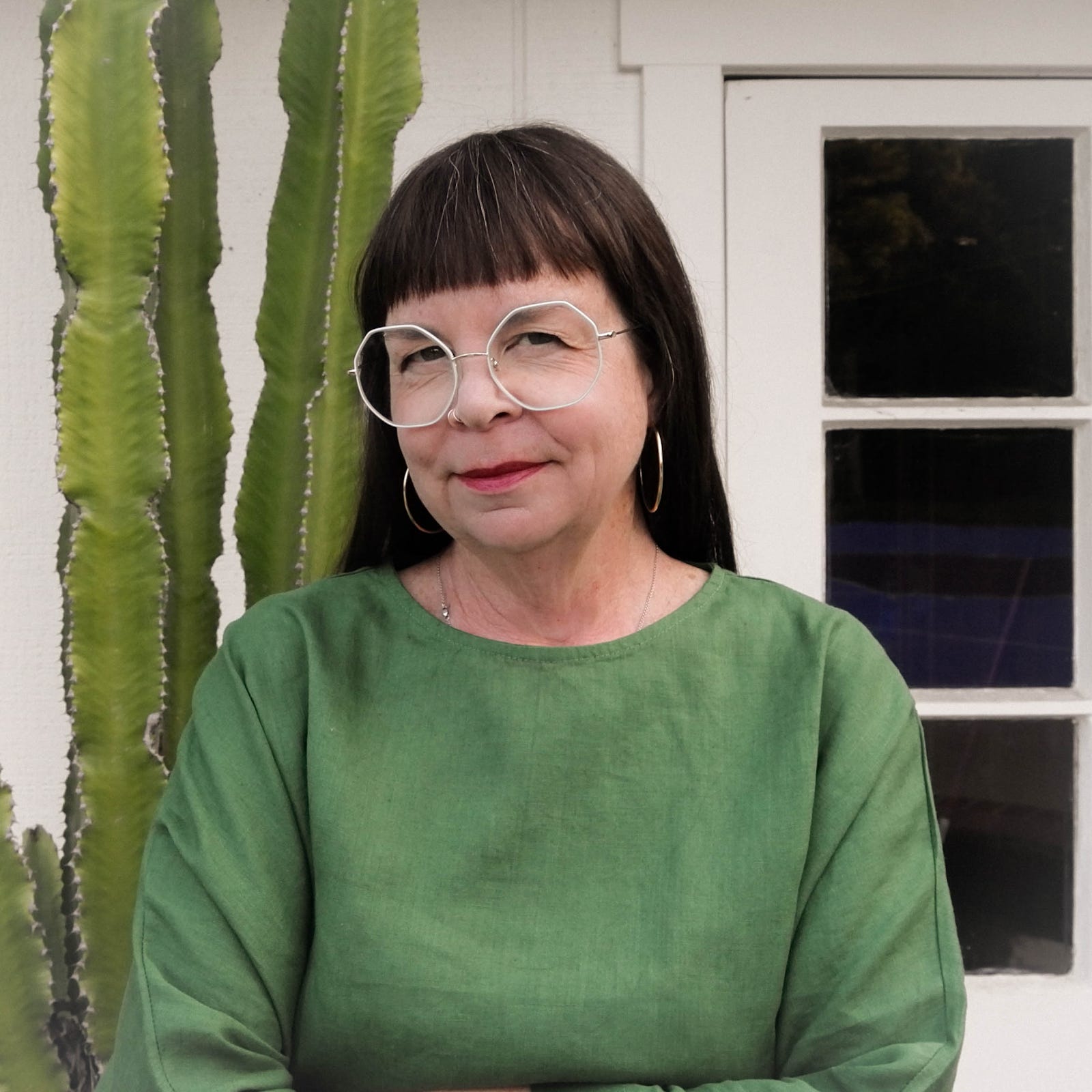
Linda Michel-Cassidy has always struck me as impossibly cool. She gives off a singular creative energy, which comes across in her style (who else can pull off these glasses frames with such panache?)—her quick, deadpan humor—and the range of writing and visual art she creates across genres and landscapes. Linda’s debut short story collection, When We Were Hardcore, was the perfect companion for me this summer while I was on the road, doing a lot of people watching. The characters in these stories frustrated, amused, and unnerved me, and each story built toward an ending that somehow felt inevitable and surprising, every damn time.
David Gates says of her book, “The meticulously written stories in Linda Michel-Cassidy’s When We Were Hardcore take us to marginal spaces: not just edge-of-the-grid stretches of rural New Mexico 'where the postal service won’t go, but UPS will,' but the seasonally-employed fringes of society and the secret corners of the human heart. Michel-Cassidy is a smart, sly yet compassionate observer of how her people do their jobs, how they talk—what an ear!—and how they manage to take care of themselves and each other.”
I really needed to hear what Linda shared about swimming & physical activity helping her empty her mind and kick-start writing, and the power of courting surprise and finding a writing group. If you don’t know Linda yet, you’re in for a treat. Read on, friends… (& if you’re reading this in email, click HERE to read it in full!) 🌊
What are your writing/creative practices? Do you have any rituals or habits that help you?
I wish I could say that I get up at 5 a.m. to write, or that I have any kind of a schedule, but I do not. I prefer to write late at night when it’s still. I fought this late night-ness for a while, but eventually gave in. I carry a notebook everywhere. They are littered about: in my car, my backpack, my gym bag, and I have tiny notebooks and a pen on me always. A lot of things come to me at inconvenient times, but I know myself well enough to know that I won’t remember them. Then when I am home, I type these little notes up, and then they will become some larger idea. Or not.
I work at my local library in Mill Valley and, like everyone, at coffeeshops. I wear noise-canceling headphones a lot of the time and play sounds or ambient music that fits the vibe or tempo or geography of what I’m working on. I’m distractable, so working away from my home is productive. Otherwise late at night.
I don’t know if this is a ritual, but I always have a book or two with me, usually a poetry book and a story collection, and I’ll read a bit before I start. Also, I am not a person to stare at a blank page, so if that happens, I’ll read then, as well. I also have walking as a block-breaker.
What are your mindfulness practices? Do you have your own definition or way of thinking about mindfulness? Can you describe your practices and what they bring into your life?
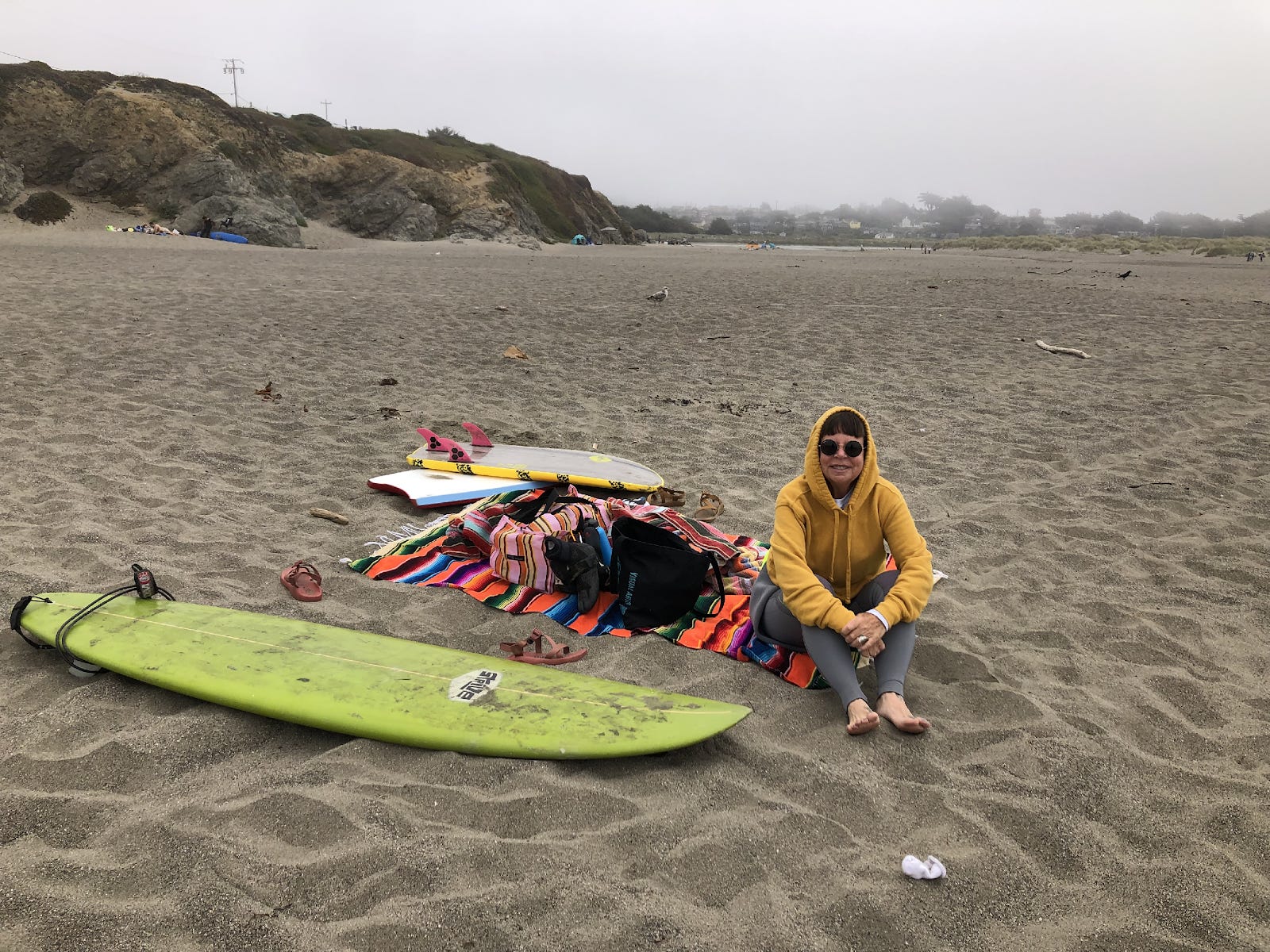
For me, it’s swimming. It is immediately meditative, and my mind starts spinning (in a good way) just a few laps in. I love the small sounds heard when in the water, and how besides thinking, all one can do is be in their body. I have a weird crawl kick, so I focus on that, trying to correct my wonky muscle-memory.
The trouble with composing when swimming is that I have to somehow remember what I’ve come up with. I write a lot of poetry in my head while swimming. I’ve heard people say swimming laps is so boring, but I’ve never run out of things to think about. I do think it’s a kind of mindfulness, because in swimming, I am hyper-aware of my body, what it can do, while at the same time directing my thoughts—which includes a sort of empty mind, when that sort of thing is called for.
Plenty of times, I’ve finished swimming with no memory of what I’ve been thinking about, and I’ll feel emptied, mentally. It’s impossible to emerge from the water in a foul mood.
Do you have a mantra or motto related to your creative/mindfulness practices/life?
I don’t have it posted per se, but something like “know and answer the needs of your mind and body” would be what I’d say. Discard the idea that discomfort is a necessary element of the writing life. Drink water, coffee, whatever you need. Get a chair that won’t give you a backache, good lighting. It’s all part of dedication and focus. Showing up in whatever way works.
I have a postcard up that says: “You are not lost. You are here.” That is useful in writing, as well as in life.
Also, writing towards the questions. Basically, if one has all the answers, then why write? Being lost or disoriented, or in some way shifted is a crucial part of writing, particularly for new material. I like the idea of courting surprise.
What helps you when you get stuck with your creative/writing or mindfulness practices?
As I mentioned above, moving the body. Physical activity and flow are interconnected, no question. It’s also very good for problem-solving. So many times I had a glitch when writing a story, and a good hike loosened my mind, and the solution would just pop into my head.
I also find that listening either white noise or music without lyrics helps. My mind can get a bit chaotic, and these things help me with new ideas as well as with blocking out distractions. I’ve become a bit more dependent than I’d like on these sounds, but for now, as it gets me into the right state, so be it.
And of course reading. Always reading. I like to have books with me in a variety of genres. Or better yet, at the library, I’ll pull a poetry book or two, maybe an art book, and then a story collection or lit journal. I also have ongoing writing that can be edited. I can always revise—I love doing it, and I’m immediately “into” whatever it needs. When I’m editing, and even a small change feels right, it sort of recharges me for new work. New writing makes me feel unhinged, but in a wonderful way, and revising reminds me that I’m competent, that I do know how to write.
What does the phrase “beginner’s mind” mean to you? Does it connect to your creative and/or mindfulness practices? How?
I can’t say that this is the correct definition, but to me, it means working without rules. The freedom to do things, particularly those creative efforts, without being bogged down. I don’t mean rules such as grammar (I’m something of a traditionalist on that), but maybe the idea that a story should have a certain shape. If one doesn’t know or isn’t beholden to those strictures, then the whole wide world available.
I do object to the notion that it’s “play,” which I’ve often heard people say. That term, to me, can sound like an insult to the effort made. A dismissal. Working with freedom doesn’t mean that creating with effort and intention hasn’t occurred. I dislike when the creative arts are minimized to random efforts, something less serious. I mean, how can one be so exhausted if it isn’t some kind of work?
But back to “beginner’s mind.” I think it can mean proceeding with a mind that is receptive to whatever happens, that openness meaning the writer/maker will attempt to be unfettered with preconceptions. Maybe that means what the work is about or how it will look on the page—maybe it even means genre or whether in the end it will be private or for the public. Not being beholden or copying what went before. Being receptive to whatever happens.
Are there any books / writers / teachers / approaches that have been transformative for you that you would recommend to readers?
Ages ago Ben Percy talked about his writing schedule. I was particularly taken with how businesslike he was about it. Particularly with submissions. He set apart a time and set goals and was regimented. It really impressed me, that yes, we do the creative work, but that this other part needed to happen, that maybe it’s tedious, but it must be done if we want our work read. I’ve treated that aspect of my writing as a project that must be done. In reconceiving what that part of writing is, I’ve freed myself from finding it boring or tedious. Well, sort of, I mean, it’s both of those, but I think of it as an obligation that one just does, rather than somehow tied to creativity.
Bret Anthony Johnston said a number of very smart things about being generous when writing characters who make bad choices and/or would be seen as unwise. It has stuck with me for many years, and I’m paraphrasing, but that we need to offer all of our characters the grace and space WITHOUT JUDGMENT to make mistakes. It’s become a goal of mine to never write the trope of a unintelligent or fully “bad” character, that these folks need the most attention and care. I saw this enacted in Jill McCorkle’s and Daniel Woodrell’s writing, and have made it a hard and fast rule for my own. I think Miranda July embodies this in her writing—she never looks down on her characters when it would be so easy to do so. It’s so easy to let a “bad” character be the two-dimensional fall guy, but these folks always have a backstory and some reason they learned to behave the way they do. Bret also said, “always assume your characters are smarter than you are”—which is amazing advice.
What advice would you give someone who is trying to start or restart a creative or mindfulness practice?
I think being with a group really helps. A class, a small group, just being somewhere where other people are writing. I’ll just say, from personal experience, that’s what did it for me. I’m a metalsmith, and some time ago I had a surgery that made me unable to stand or lift for quite a long time. It was a real challenge for me. I don’t even know what compelled me—cabin fever, I guess—but I signed up for a community writing class that was offered as a fundraiser for my daughter’s school. I’d been writing in journals and about art and some newspaper pieces, but nothing that was both creative and for public consumption. Well, not only did this class shove me into the writing life, but I also became close with several of the people in that class, a group of us, who are still writing comrades. I think we collectively began to think of ourselves differently. I had my book release in that town, at the place where we took those classes, and so many folks from early classes turned up. I absolutely would not have become a writer without these folks!
When I taught community ed, so many writers turned out to be writers in some sort of freeze or holding pattern, or maybe seedlings who didn’t have confidence. And to be honest, they produced some of the most off-the-hook interesting work. Kind of beginner’s mind mixed with combustion. Also, I’d see a lot of “I’m not a real writer” business. Are you typing or writing words about things you’ve made with your very own brain? Guess what: You’re writing!
A Prompt from Linda
One of my favorite end-of-session things to do is a prompt or line exchange. This can certainly work with a small group of writing friends, as well.
I have each student send me ten lines that they like or hate or are particularly taken by (including the credit, if it isn’t their own). This is including “darlings” they have cut from their own work.
Then I print them out in strips, put them in a box, and on the last day, we go around the room and pick strips until they are used up.
I give everyone a small envelope for their new collection, so that they have “assignments” for in-between sessions. We have also done this with images, and when we were virtual, I used a scrambler and emailed them their prompts. I love the Spoonbill language generator. There are other language generators as well, which all have their roots in the Oulipian practices. I heard about these during art school. I think they are great tools for not only jumpstarting, but for making writing fun and open.
Is there something you were hoping to share that isn’t here? Tell me about it.
Just that the writing life isn’t limited to the act of writing. Go to readings, buy books or check them out from the library. Read reviews, write reviews, write essays on Substack, do a podcast, post pictures of books you like, make your own writing retreat with some friends—even if it’s just for a day. Be with and support your people.
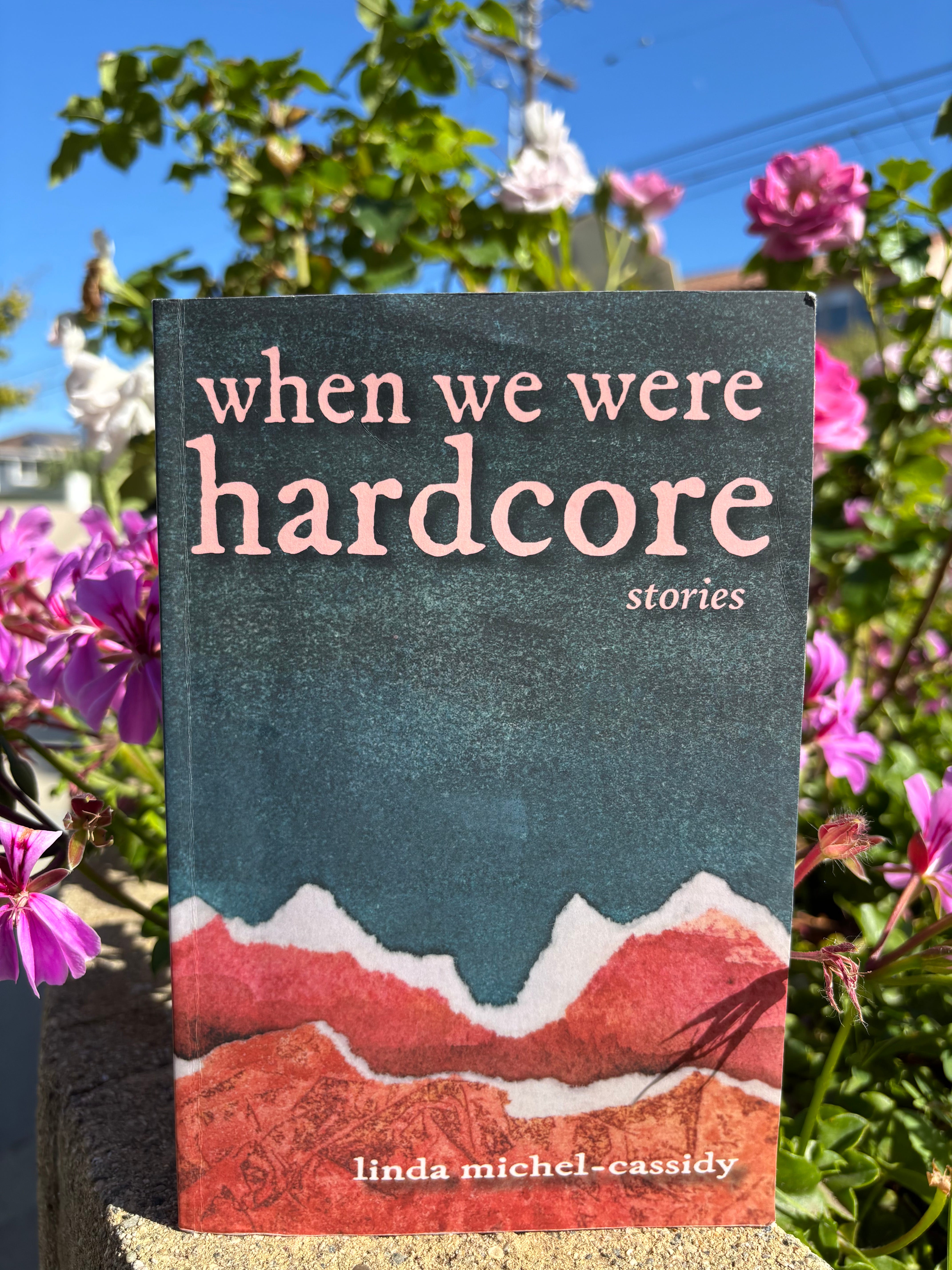
Linda Michel-Cassidy’s debut story collection, When We Were Hardcore, was released by EastOver Press in February 2025. Michel-Cassidy is a senior editor for book reviews as well as collaborative and cross—disciplinary texts at Tupelo Quarterly, where she also contributes criticism. Michel-Cassidy teaches workshops in experimental prose, flash fiction, and editing. She was a contributing editor at Entropy Magazine, where she edited podcast reviews, wrote reviews, and conducted interviews.
Michel-Cassidy holds MFAs in fiction/nonfiction from the Bennington Writing Seminars, in poetry from the Vermont College of Fine Arts, and in visual arts from the California College of the Arts. She has an editor's certificate from University of California, Berkeley, and has attended residencies at the Sewanee Writers' Conference, Breadloaf, and Tin House. In 2025, she was a cross-disciplinary resident at Residency at the Farm, in Argylle, WI, and in 2026, she will be a resident in writing at Write On Door County, also in Wisconsin. In 2018, she was a cross-disciplinary resident at Gullkistan in Laugarvatn, Iceland.
Michel-Cassidy is a voting member of the National Book Critics Circle where she reads for the translation prize, a board member of the Marin Poetry Center, for which she edits the annual anthology, and a juror for the Northern California Book Awards. She is a member of The San Francisco Writer’s Grotto. Michel-Cassidy is at work on a collection of brief nonfiction, a poetry manuscript, and a collaborative novel with the writer, Cathy Maclin. She is a metalsmith and installation artist, and swims open-water with the San Francisco Dolphin Club. She lives on a houseboat in northern California and in an old adobe in rural Northern New Mexico.
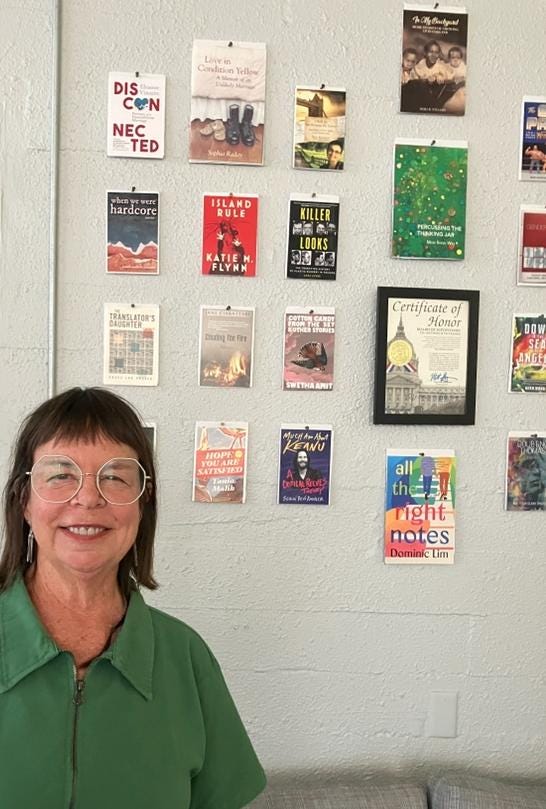
More from Linda 🌊
Learn more about Linda’s work at her website: lmichelcassidy.com
Order your copy of When We Were Hardcore from your local indie on Bookshop!
Follow Linda on Insta: @lmichelcassidy, on FB: Linda Michel-Cassidy, and on Bluesky: @lindamichelcassidy
Watch Linda read at Second Sunday Readings on Youtube
Read Linda’s fantastic interview with Allison Wyss at Hunger Mountain
SOMOS: Based in Taos, New Mexico. If the Grotto is my home, SOMOS is my literary birthplace. I took my first writing classes here, volunteered as a youth mentor, attended untold numbers of readings, and now teach for their summer writing conference. They also have a great used book shop.
Tupelo Quarterly: I am one of the senior editors here, for reviews and also for hybrid/collaborative works. I consider reviewing and editing to be an integral part of my writing life. I focus on small presses, works that have wrongfully escaped attention, experimental writing, and writing in translation.”
The Dolphin Club: Random? Perhaps. This is where I swim. It’s open water, very old school. I do a lot of thinking and forgetting right here in the bay. I also like to write here after a swim, in the room up top that looks over the lagoon. Swim, sauna, bag lunch, write—can’t beat that! There is an enthusiasm here that spreads into my writing life.
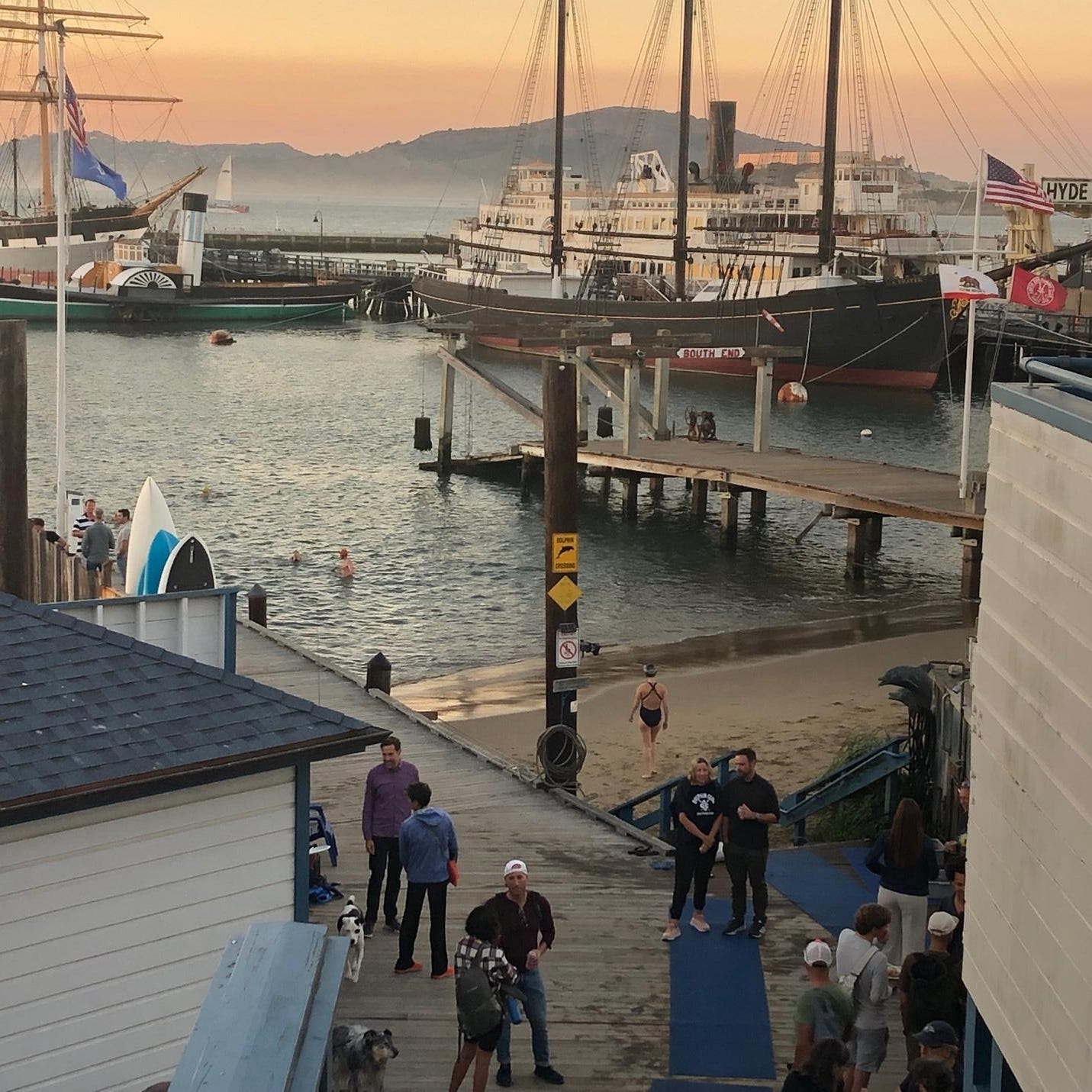
The Dolphin Club, Aquatic Park, SanFrancisco, CA. Post-swim view from the cozy top floor.
What You May Have Missed on Be Where You Are
On Mon, Sept 15th, Catherine LaSota will be our Guest Host! Then, on Sept 22nd, we have our monthly FREE session & it’s our Fall Equinox party w/prizes and giveaways! Details below👇🏼


Before you go, will you take a moment to hit the heart button or leave a quick comment? This one simple action is incredibly effective at helping to spread the word about Linda’s work!
🌱 Be Where You Are is 100% reader-supported. You can support this work by becoming a paid subscriber for 5$ a month or make a one-time donation here if you value this work but can’t subscribe. Or, just send it to a friend! 🌱
Be Where You Are is a newsletter about how to use writing and mindfulness to live more fully where you are. To reply to this newsletter, just hit reply. I’d love to hear from you! You can also find me on Instagram/Facebook/Bluesky or find more info at my website.
Loved this interview, adding this book to my list for the fall. Always good to see you Emily pop up in my inbox.