
“hell yes or hell no?”
late poet, teacher, and seeker Bobbie Ogletree on her meditation and writing practices and poetry as a path to waking up 🌊

This is a Beginner’s Mind interview, a series that explores the intersection of mindfulness and creative practice. Zen master Shunryū Suzuki Roshi said, “In the beginner’s mind, there are many possibilities; in the expert’s mind, there are few.” This series shines a light on the practices that sustain people in their daily lives and open the path to new possibilities. Subscribe below for free to make sure you don’t miss any future interviews. ✨
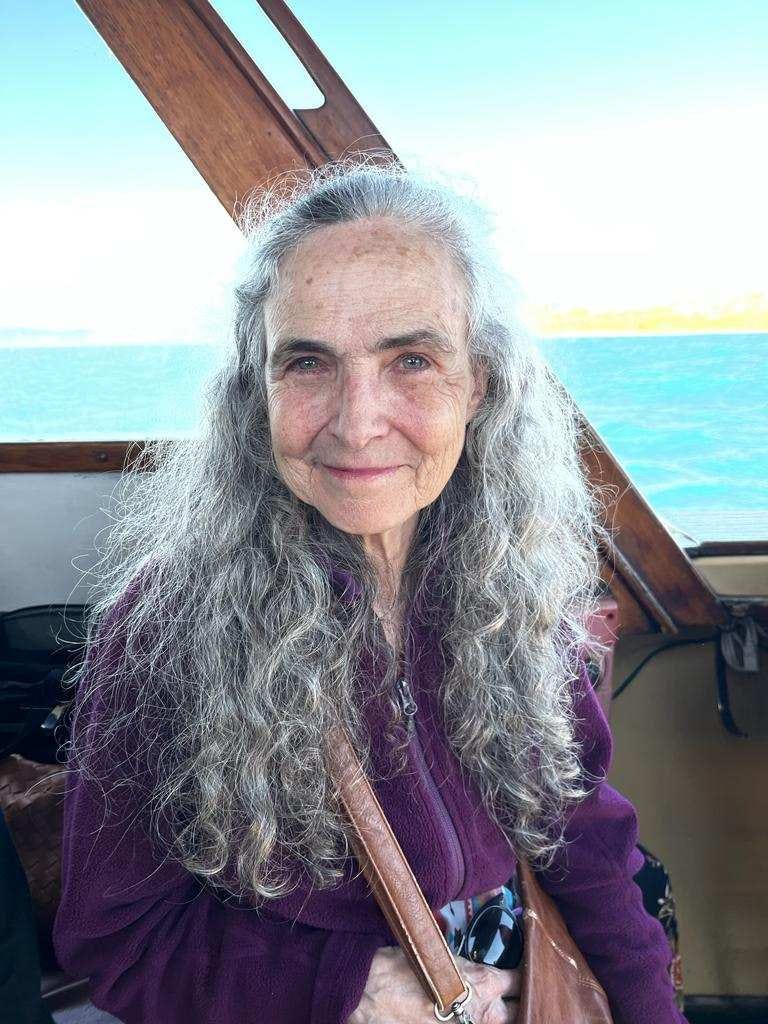
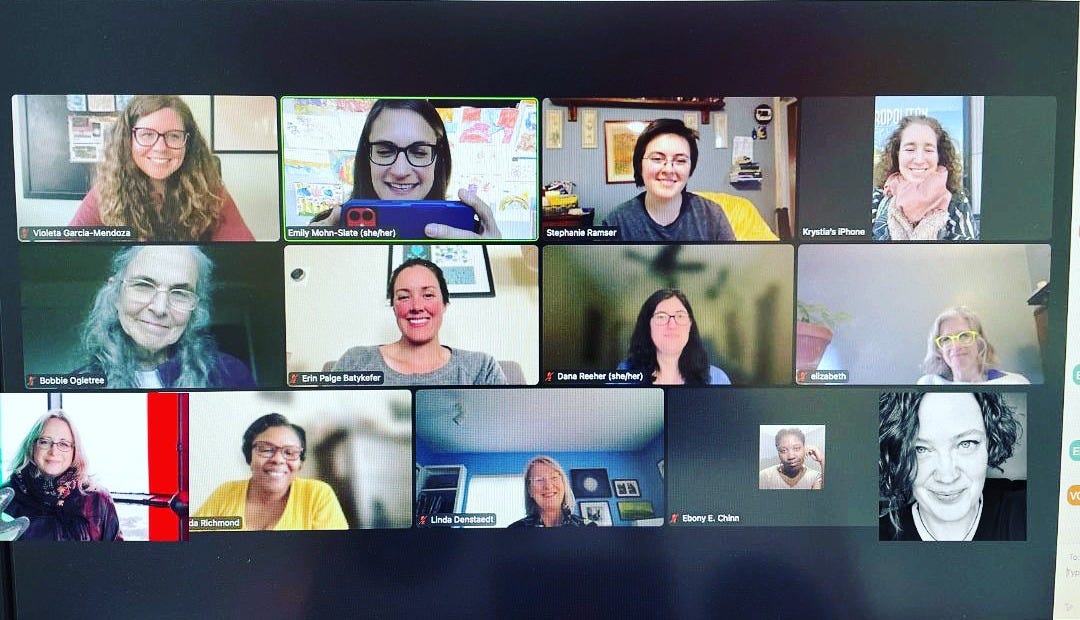
Today, I’m very excited to share an interview with Bobbie Ogletree. This June, it will be two years since Bobbie died after a year-long battle with pancreatic cancer. I had the great gift of working with her on her debut poetry collection, The Blue Hour (MadBooks, 2024), which she finished over the last year of her life. Bobbie had a profound impact on me and I count her as one of my greatest teachers and friends. She showed me how to face fear and pain with humor and courage, and how to use poetry, as she always said, as “a path.” Poetry as a way to be awake in this world.
I am deeply grateful that she did the hard work of compiling and honing her poetry collection, even when she was facing death and in so much pain. And, I’m grateful that she gave her precious time and energy to have this conversation with me so that I can share her considerable wisdom about her mindfulness and writing practices with you.
Bobbie’s spirit is still very much in this world. I feel her close as I read her wild, wise poems. I can hear Bobbie reminding me to relax, to laugh at myself, to keep going. The other day, I opened up her gorgeous book, The Blue Hour, and a letter from her dropped onto the floor. In it, she wrote, “It appears that my time for being here is short. And I have taken your advice about focusing on the manuscript. Maybe some new poems are awaiting me but the ill body does not play, is demanding its due. Who knows though? What were the chances of Eloise hearing about Madwomen, Covid coming and putting the program online, a space opening up at the last minute in that first class of yours I took? Magic was afoot, magic is afoot.”
Bobbie Ogletree was magic. How can I possibly convey to you just what made her so vibrantly alive and utterly unique? How can I make you feel her wit, tenderness, intuitive powers, and deep spiritual wisdom? I can’t, but you can feel it here in her words and the truth underneath her words.
At the beginning of our conversation, Bobbie was having a lot of pain, and she promised to tell me if she needed to cut our conversation short. She shared that her death doula, Erica, had advised her that her new mantra should be, “If you want to do something, it’s “hell yeah.” If you don’t want to do it, it’s “hell no.” She said, “That’s it. That’s your mantra now.” I carry this with me as I try to honor Bobbie’s spirit. Read on, friends, to meet Bobbie, and if you’re already lucky enough to have known her, to remember her and receive this gift. And, if you’re reading this in email, click HERE to read it in full!) 🌊
What are your mindfulness practices?
I practice meditation daily. The practices differ depending on posture, of course. If it’s a formal sitting posture, the goal is to be really aware of the spine as well as touch points—how my behind feels on a cushion, for example. The way my legs, if they’re in half lotus, go over each other, or if they’re not, the way they touch the ground. Really strong awareness of posture is the number one.
I remember Chögyam Trungpa Rinpoche talked about sitting like a king or a queen depending on your gender. Not in a rigid way, but as if there’s a string between you and the sky. You’re suspended but also connected. The posture will ground you and give you a start on mindfulness.
How did you begin with your mindfulness and meditation practices and your connection with Buddhism ?
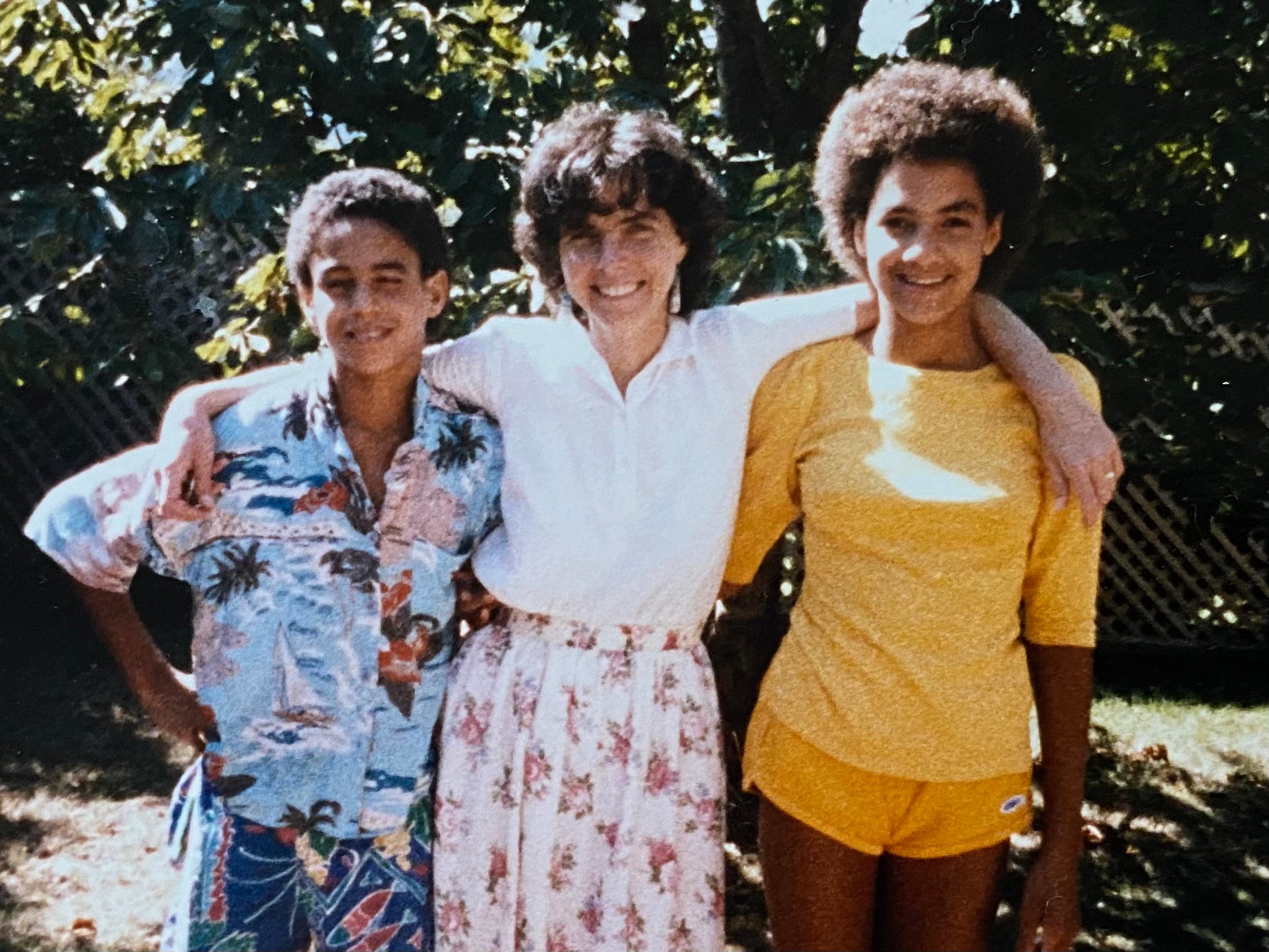
My daughter, Shoshana, was a baby. We were living in this commune and we were poor by choice. We could have gone back to the life of middle class college degrees but I just found that I wanted something else, you know. I found myself in basically a good life but a suffering life. They say that a lot of people come to the path because of suffering. And I think most people do because they want something different and they see that what they’re doing isn’t working. I kept running into people who kept telling me about Vipassana and these 10 day retreats. My first response was, “Hell no, I’m not gonna go and not talk for 10 days.” So I ignored it. And then finally, I was sort of broken up with the kids’ dad and it was misery and one more person mentioned it and said he had information on the next retreat. I took it and decided to go.
The retreat was on one of the Gulf Islands. I always say, “If I’d have been a good swimmer, I would have swum away from it because it was so rigorous.”
So I did it, I stuck to the program and was pretty much transformed by it in so much as I decided I really want to understand this and practice Vipassana. I didn’t have a clue most of the time what he was talking about, and that was ok. Some things made no sense and others clicked in and made good sense.
One thing that impressed me about our teacher was that someone asked, “Is it bad karma to have an abortion?” and he didn’t say anything for what felt like minutes. Then he said, “Well, it’s not the best thing you can do, it’s not the worst thing you can do.” He held it in non-judgment and I thought that was really just a wonderful way to handle it. And he was very clear that he didn’t have the capacity or the right to make a call on it.
He also came from the Catskill mountains and we knew each other’s families. At the breaks, we would have interviews with him so that we could ask him questions about the path and the retreat. Instead, we’d talk to each other about our families, like “How’s your sister?”
Emily: That tracks. You are such a seeker and you’re so committed to the path, but you hold it loosely. And, you value connection over some rigid notion of perfection.
Bobbie: I call it Vipassana Light Touch. It didn’t come down on you like a hammer. It was doing what you could do, watching what was difficult, and I feel that that embraces a kind of practice that makes sense, rather than a rigid routine.
Is it mostly sitting meditation?
Sharon Salzberg was the second teacher at this retreat, and we did both sitting and walking meditation. I liked walking meditation initially as a diversion; it’s not really a diversion, you have to be with yourself. I prefer sitting; I can sit way longer than I can do the walking meditation. But walking is another way of calming. And it definitely slows things down. I like how you can vary the pace. But we did long hours of sitting.
Emily: How long do you typically sit?
I used to set a timer, but I don’t do that anymore. I sit as long as I want to, and then I hear the teacher say, “You can sit a little longer. Go a little further.” And I almost always end up doing a little more. I’ve been doing it so long that I can feel when I’m at a half hour or an hour. Sometimes I get caught in feeling like I should sit longer, but I’m trying to throw that out—the shoulds.
What do you do when it’s really just not working?
A few things. I just have patience through it and say to myself, “It’s not working.” That’s the practice today.
Or, I change my posture. If I’m sitting, I stand up and walk. I try to work with the breath so that I go right back to concentrating on the breathing. I do the old Zen rising and falling of the abdomen and from Vipassana, I learned the practice of labeling (“rising falling rising falling). So, I’ll go back to that when I’m stuck.
Also, “eyes closed, eyes open.” The first few days of a retreat, I’m so sleepy, with my eyes half closed on the cushion all the time, and then it just disappears, just like that. I was taught to have my eyes closed and then when I started doing more meditation with Shambhala, they said “eyes open,” but then somebody said, “Eyes however you want,” which is basically what I do.
Shifting to a different practice can help. Get up and walk around and don’t worry about it. Sometimes you’re hungry and you can’t eat because you’re at a retreat, or maybe you’re thirsty, maybe you need to go to sleep. You can try lying down and think you won’t fall asleep and the next thing you know, you’ve actually definitely been sleeping.
Do you see your meditation practices as connected to your writing practice?
I never did for a very long time. I saw them as quite separate. But I think the longer I did the writing, which came second, the more I started seeing, if you’re waking up over here, you can wake up over there. I found that I think the practice gave a tremendous opening to letting things come in and staying aware that they could.
Where do the words come from? Practice seems to engender the space for them to appear. Also patience because I’m very impatient. If you had told one of my teachers from my school years that they’d find me at a meditation retreat sitting still for an hour at a time, they would have laughed their heads off because I just couldn’t. And that changed so drastically. The meditation gave me patience. And the patience transferred to being able to sit with a blank page more, being able to accept that there’s nothing here today or maybe it’s just brewing.
When did you start writing?
When I was in high school, I was always praised for my writing. But I don’t think I really started paying close attention to my writing until well into my 40s and 50s. On a whim, I applied for an arts festival where you sent in a batch of poems and if you got selected, you had this weekend with a published author. And I got picked to go to this conference. That started it. I was just hitting 50. It was very late and I had absolutely no faith that it would ever go anywhere, or that it would have that much meaning for me.
And, [my late husband] Freye was already deep in writing for so many years and he would say to me, “You have to write. Your well-being depends on it.” And I thought he was really over the top with it but he was quite insistent.
Emily: I love the note you have in your acknowledgements from him: “Duckie, you have to write.”
Bobbie: That was him. He also had this meticulous filing system and I’d say to him, “I can’t find that poem and he’d say, just look at a shoebox under “F.” Maybe you threw it in a shoebox somewhere. My lack of organization was a thorn in his side, definitely.
Emily: I love that…I know you mostly as a poet. Did you start writing prose when you started or was it poetry?
Bobbie: It was a mixture. But I think I naturally gravitated toward prose because it was storytelling. I liked telling stories. But then I would fool around with the poems and I thought they weren’t very good. They were all over the place. It started with prose and then poetry found its way in.
What’s your current writing practice like? I know it’s different because of your illness. So you can also speak to what your writing practice was like before when you had more energy?
Joining Madwomen in the Attic was an incredible impetus to write. And it changed my writing. Before this diagnosis, I had a lot of enthusiasm about writing and I could feel that it was something I wanted to not push on so much as explore. And even when I thought I’d run out of ideas, and I didn’t have anything to say, there was this niggling thing in the back of my mind saying, “Yes, you do.”
And the diagnosis took it away because it changed the focus, of course, and it called in how temporary everything is and it just rearranged everything. The shift is quite profound.
And then there’s just well, what do I do with all the stuff I’ve written? What does it mean? It’s brought up a lot of questions: Who is the keeper of the writing? I always said it would be Freye. We always said we’d keep each other’s writing going in some way but you know, life, it just does what it does.
It’s confusing at times and I’ve been thinking about who to trust with it? And, sometimes I just can’t figure it out and I just let it go, let it dangle. If I can’t figure it out, I can’t. So.
Is there anything you want to share about where you are now with your book and your writing practice?
I am working on the book and it’s been my focus and it’s been such a wonderful gift, but I still have poems and things filtering through my head that aren’t related to the book. That excites me. Things have broken open, so ideas are coming, but then I get sad because I’m dying, so what am I doing with it? Then I go back and forth between the two, and I say it doesn’t matter, today’s today.
A lot of silly poems are coming—jingles, like I’ll get a pain and say “There’s the cancer dancer.” I can still joke, which is good. I think I’m always writing now, it’s just in different forms. And then as we’ve been working on the book, the book really grabs my attention especially when I think something’s off, I have to do something with that.
Of course I’m working with a very strong fear element, a fear of dying. I’ve never been a super social person, but now when people are going to come over for a visit, I’m very nervous because I don’t know if I can do it. And I worry they’ll come over here for nothing. But that’s the practice. The practice is to deal with whatever comes up. To say, ok, this is what I have to work with.
It’s similar to the writing. Where do the writing ideas come from? You might have an idea that’s abhorrent, you don’t want to write about it, but there it is. It wants to be out there. It’s the same thing with the daily fear. It’s just that’s the hardest. The fear and the dealing with just having physical pain that won’t go away. We’re trying a new dosage and I think there’s some improvement with that, but last night, I was a mess. I just had so much pain. And Shoshana is doing a cleanse, so she had a terrible headache, and I had a terrible stomachache, so we were like matched up diagonally. I said to her, “get off the cleanse, you don’t have to do any of this!”
Emily: I really appreciate the humor and perspective that you bring into everything. I’m grateful to hear you talk about it in this way. I treasure this. I just wrote down, “That’s the practice.”
Can you talk a little bit about your process with the book?
I’m very excited about it, as excited as a person can be who has cancer and is in a lot of pain. And, I’m first of all astounded that it’s happened—that I have a book, and I feel really proud of it. I feel really good about it, I feel that it’s a measure of what I’ve gained from all my years of writing and from our Madwomen workshops. All the work I’ve done with writing groups, esp my writing group from Nelson, which is just a stellar group.
The book also gave me this opportunity to work in a collective group with you and Eloise and Linda, to edit and do this work together as a group. It was such an interesting experience to go through this.
It was kind of hilarious with the ego – I went into it thinking, I’m so happy to have input and I feel so open to feedback, and then as we were working on it, I kept feeling like “This is my poem! I don’t want to change a thing!”
How do you work with hard mental states with mindfulness?
The first thing is not running up against them like a brick wall. Accepting that you’re in a really hard state. You need to bring gentleness to it, it’s so important. Most of us don’t pull that off very well. We do the opposite.
Sharon Salzberg’s metta meditation sounds so simple but it really isn’t. And that’s why I think she has such an order for it because she understands people have a really hard time.
What does your metta practice look like?
It’s a mess. I used to have an order during my rigid stage and I honestly can’t remember it now. I start with wishing myself well, then family, then people I know, then people I don’t know, then the enemies list (and I don’t really like that term). Now with my sickness, I’m more focused on others that have the same kind of struggles, conflating what’s going on with me with the same things happening to other people. It’s not taking on their illness, but it’s recognition that others have this suffering and we share in it.
And then because of the Bodhisattva stuff, I have vows. I have things I say every day but boy, have I been slipping on that one. I blame it on the drugs. I can’t get comfortable with my body so instead of sitting in half or full lotus, I bend down and I find myself sleeping and doing these vows and it’s a tremendous lack of clarity but that’s what happens. I want to do the vows. They’re important to me. I do the bodhisattva vow. There’s so many versions of them, and as Norman Fischer says, they’re all impossible to pull off, but it’s a goal. Whatever virtue you accumulate, they say, with meditation and kindness, you dedicate it to the well being of other beings.
There’s a vow called The Four Immeasurables where you wish people well being in different forms. Then the refuge; you take refuge in the Buddha, the Dharma, and the Sangha. Really, I do a combination of things. One of my original teachers would say: do not do this. Don’t dig little holes and not dig a big hole where you just really focus. But this is natural to me.
The metta prayer—to me now, is praying for what’s going on in the world, it can be anything you want it to be. Praying people have food, have shelter, it’s endless. And it’s necessary.
You’ve talked about bringing mindfulness to all the practices in your life, like parenting. Can you talk a little about that?
There’s no other teacher like parenting, like your children. I remember my son and daughter-in-law were living in Vancouver years ago and Sol was on the road with his client and the kids were so little—maybe four and two—and it was really all on her. He’d been gone a number of weeks. I showed up and she was sitting there crying and she said, “I can’t stand their voices.” And she felt so bad about having that feeling. And I said, “That’s completely normal. You’ve been day and night at their beck and call. And they were at the age with their screechy little voices.” I told her, go out with your friend, go get some tea, I’ll do this. Because she’s such a good mom, this feeling was repulsive to her.
That struggle so many mothers feel is on us and our culture. Parenting is beautiful and it is wonderful, but we hide so much of what the reality of parenting is—it’s hard. It really is all practice.
Just one more thing: if you’re in that situation and the sound is like killing you, there’s a way to penetrate through it, which is to be completely present with it. Where is it in the body? Where do you feel it? By feeling it, it does dissipate a lot of the time, not always. It’s that heavy pushing against it that makes it a lot harder to get through. Just to surrender to it is helpful.
Your humor seems really central to your wise approach to life. Can you talk about how you understand the relationship between humor and mindfulness?
Even in the heaviest poems, I think poets manage to pull out something that touches people through humor because it’s impossible to live on the planet without it. Humor is always there. Even writing about Freye, all this heaviness with finding truth and trying to decipher what this all means —he found it amusing at times and he had fun with it. I really wanted the poetry to incorporate that – to have something that shows that even if the thing is hard, it’s not all dark. But you have to be really careful because people can mistake humor for other things. It can get people thinking they have a right to just say what they want to say. I try to be really careful with humor and ask mindful questions like, does this actually serve anybody? Is this actually helpful?
Emily: Unlike some people, you don’t use humor to avoid reality or skate over the surface of things. I think you use it in a deep way to get at the truth or to help people be more present or to hear something. You do that in your writing and in conversation.
Bobbie: I try.
Emily: I also appreciate how you can be self-deprecating with your humor in a way that doesn’t make other people feel like they need to reassure you or pity you. You hit the tone just right and people really respond to it.
Are there any books / writers / teachers / approaches that have been transformative for you that you would recommend to readers?
Cutting through Spiritual Materialism by Chogyam Trungpa: He talks about the mistake people make when they think they find enlightenment when in fact they’ve just been covering up and not exploring the stuff that needs exploration. It’s a beautiful book and had a very strong influence on me. I was deep into perfecting that process of covering up and hiding from myself when both Sol and Shoshana were very little. I was separated from their dad when Sol was five months old. I was going to go to Oregon and live with my friend who has a Jesus commune when I picked up that book off the bookshelf and stayed up half the night reading it and thought I’m going nowhere, I have to figure this out.
Zen Teachings on the Practice of Compassion by Norman Fischer: In recent years, I’ve been very touched by the work of Norman Fischer. I just love his stuff and I’ve talked about the lojong practice in one of my poems. His writing has made me think and really inspired me. He’s so worth reading. I would go to his books when I was troubled. His books help you approach things in a new way.
Pema Chödrön’s work is important to me as well. I’ve read quite a bit of her stuff and it’s really helped me.
I was a bit of snob about Jon Kabat-Zinn’s book, Wherever You Go, There You Are. I thought it was basic but it’s not. It’s actually very deep.
[Bobbie flashes her mug that reads “Mom Woman Myth Legend”]
Can you talk a little more about how you see writing and mindfulness as connected?
I’ve had a lot of poems where I thought I had it right and then in revising, I realized that there were real gaps. I would say that mindfulness comes in with the revision process more than anything else. The initial process is all over the place—it’s just freewriting or whatever—I mean, sometimes it’s clear right away but often that’s not how it is.
Mindfulness comes in handy when I’m trying to figure out what the piece needs. Or it’s about being mindful in my day and I’ll be out somewhere and hear a line or a song and hear it calling to me and realize that’s it—these parts of the writing process are all connected if I’m open and aware enough.
Emily: How would you describe what “it” is?
Bobbie: I think “it” is the kernel of truth. What I’m trying to get at.
One of the poems I struggled most with was writing a poem about Ten Days for World Peace. That was a poem that I thought I really understood and it was working. It was about a group of priests that were touring Canada through a joint effort to help others understand what was happening in Latin America, to garner support for the Sandinistas, and to advocate for peace through liberation theology. Because I hosted two of the priests at my house, I felt like I got to know them pretty well and I understood what I wanted to write, but I could never finish that poem. And I think it’s because I couldn’t find the “it,” the kernel of truth. I tried again when we were working on the book, but I ended up integrating parts of it into other poems because I absolutely couldn’t make it work.
The beauty of the poem was that it gave me ideas for other stuff, so it was not a waste in any way. Working on the poem made me think about the struggle in Latin America and how it connects to other places all over the planet. It wasn’t confined to that particular place or those institutions. The other poem that I struggled with most is “The Map of my Lost Face,” which I think I brought to our first workshop. One of the other writers wrote in the margin, “I don’t know what you’re talking about.” I almost wrote to her, “You and me both!” It was a poem that I thought I had figured out for years, but I didn’t. The idea was that our experience of life maps our faces. We keep aging and the lines are formed by our thoughts, our experiences, and they’re not just changing skin. It felt like one of those poems that was just going to manifest itself, but it never did, it never could.
How did the Madwomen in the Attic workshops impact you and your writing?
Greatly. My friend, Susan, said she couldn’t believe the difference in my writing once I took the Madwomen workshops. I think it opened up a door to just allow expression where I was holding back more than I needed to. It gave me permission to actually write and not hold back. And also the range of topics we discussed—and, it also sounds kind of corny, but it opened up that American Jewish side of me which had gone a bit quiet living in Canada.
The community, the friendliness, too. I thought it was such a welcoming workshop thanks to you and to the long time members. It just felt so welcome and open, it really made for fearlessness. Like, let’s just write.
Emily: And that’s what you did. You came in with a lot of poems, but you were so prolific beyond that.
Bobbie: I think back to when I really started and one of my first teachers said to me when I first started writing, she said to me, “You’re so locked up, don’t be afraid to open up the door. Don’t make us look for secrets, just tell us.” I thought that was wrong, but she was right. I was holding back.
A Prompt from Bobbie 🌊
What in your life is asking you to say “hell yes”? Or “hell no”?
Reflect on this question and write into it. See where it leads you.
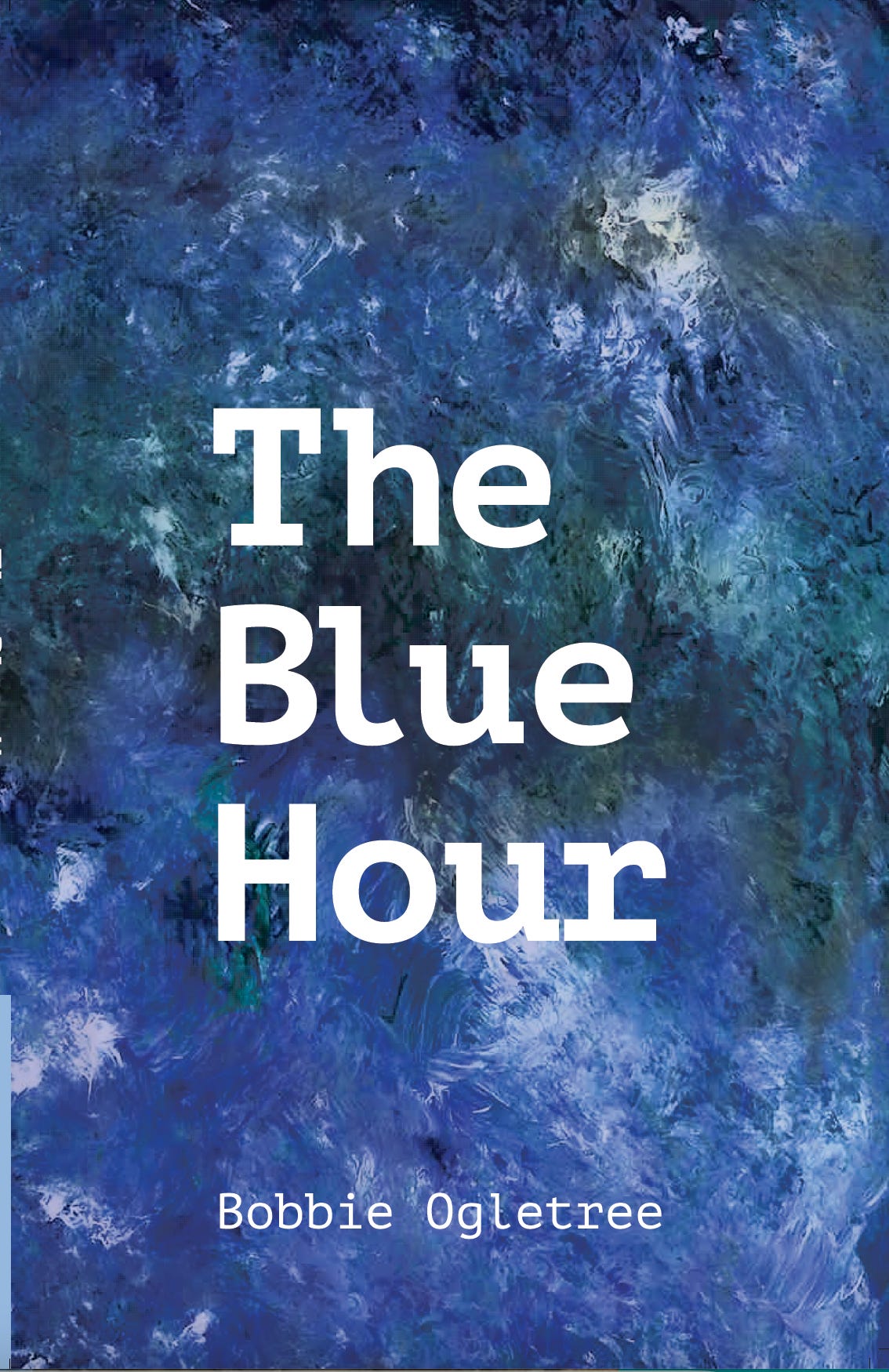
Bobbie Ogletree is the author of The Blue Hour, MadBooks, 2024. Her poetry and prose have been published in Canadian and American journals, including Other Voices: Journal of the Literary and Visual Arts, from this new world, The New Orphic Review, Wordworks, The Worcester Review, and anthologized in Rocksalt: An Anthology of Contemporary British Columbia Poets. Her work also appeared in Carlow University’s Voices from the Attic anthologies, and in The Sun’s Readers Write. In addition, three of her poems were part of visual art exhibits at the Nelson Touchstone Museum in Nelson, British Columbia and at the Art and Word Festivals 2022 and 2023 in Sechelt and Gibsons, British Columbia.
She was born and raised in upstate New York but has lived in British Columbia, Canada for more than fifty years. Her writing reflects what overlaps between the two countries and what is distinct. Universal themes include grief, our connections to the non-human but sentient world, limit and limitlessness of imagination, and our search for political and spiritual truths. Bobbie Ogletree taught English to speakers of other languages for over twenty years and is now retired in Sechelt, British Columbia. She was born Jewish but also embraced a myriad of paths, including Buddhism, as her home for meditation and prayer and the hippie “back to the land” trail. This journey has given Bobbie unexpected gifts, especially humor.
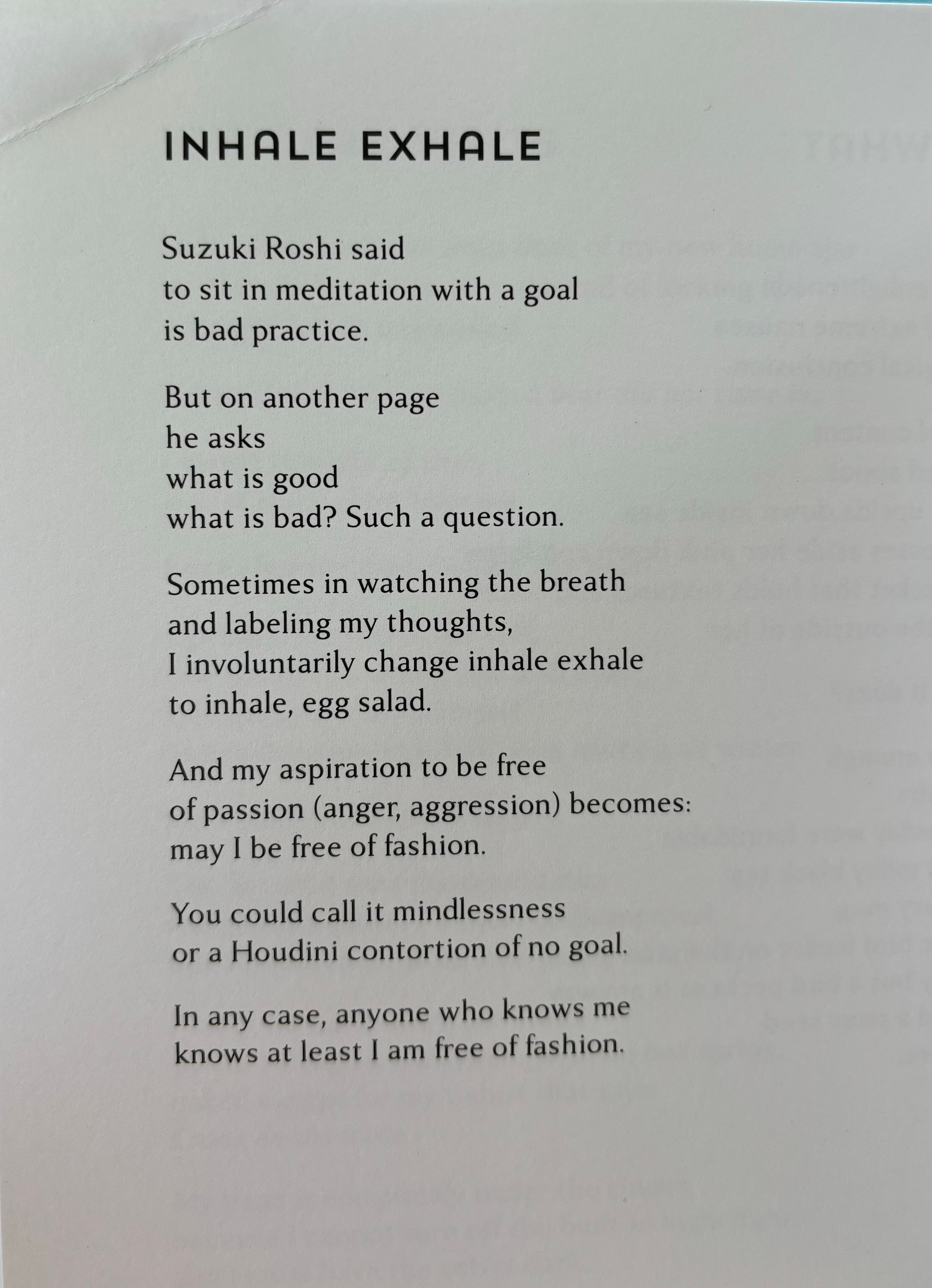
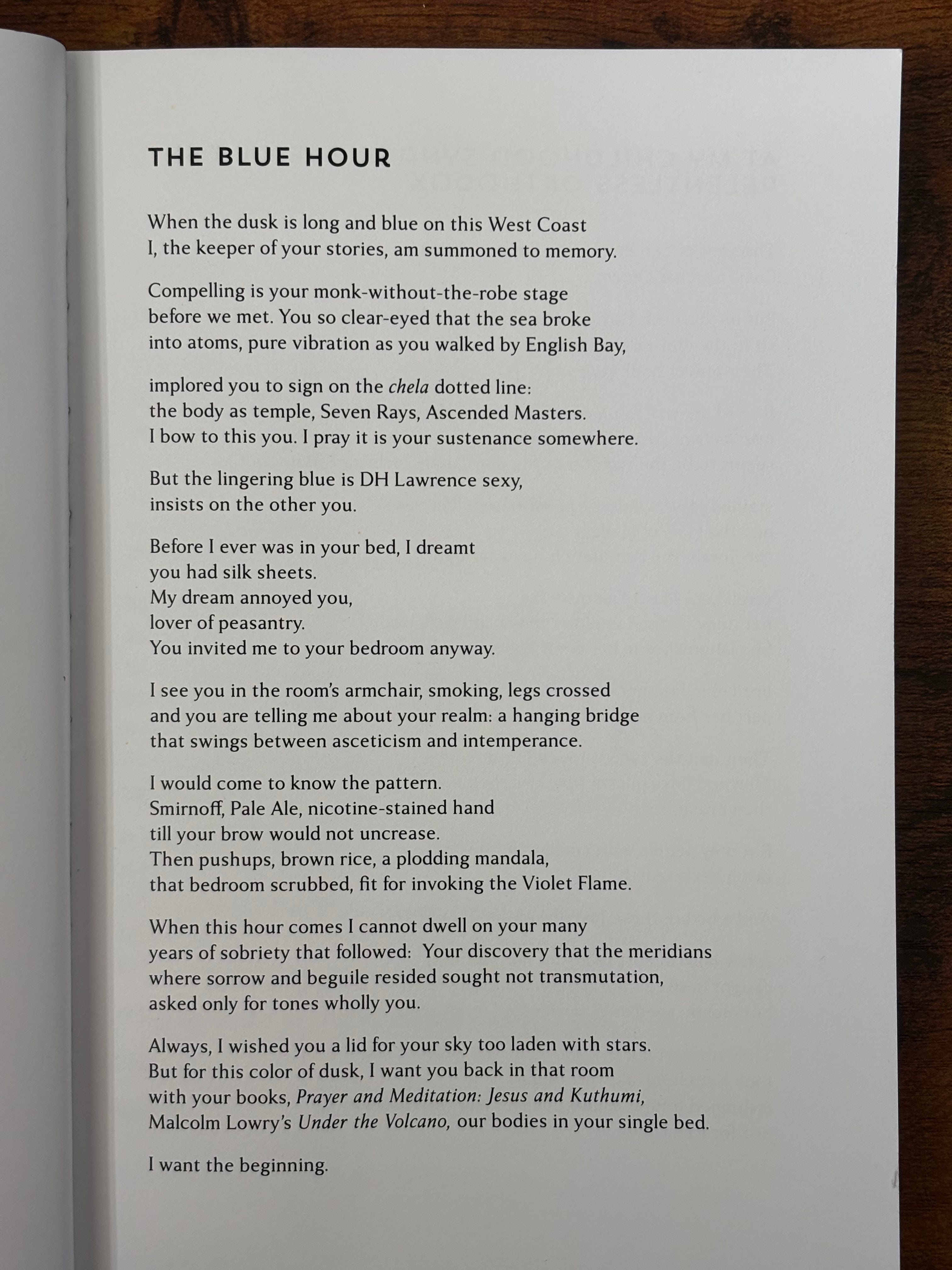
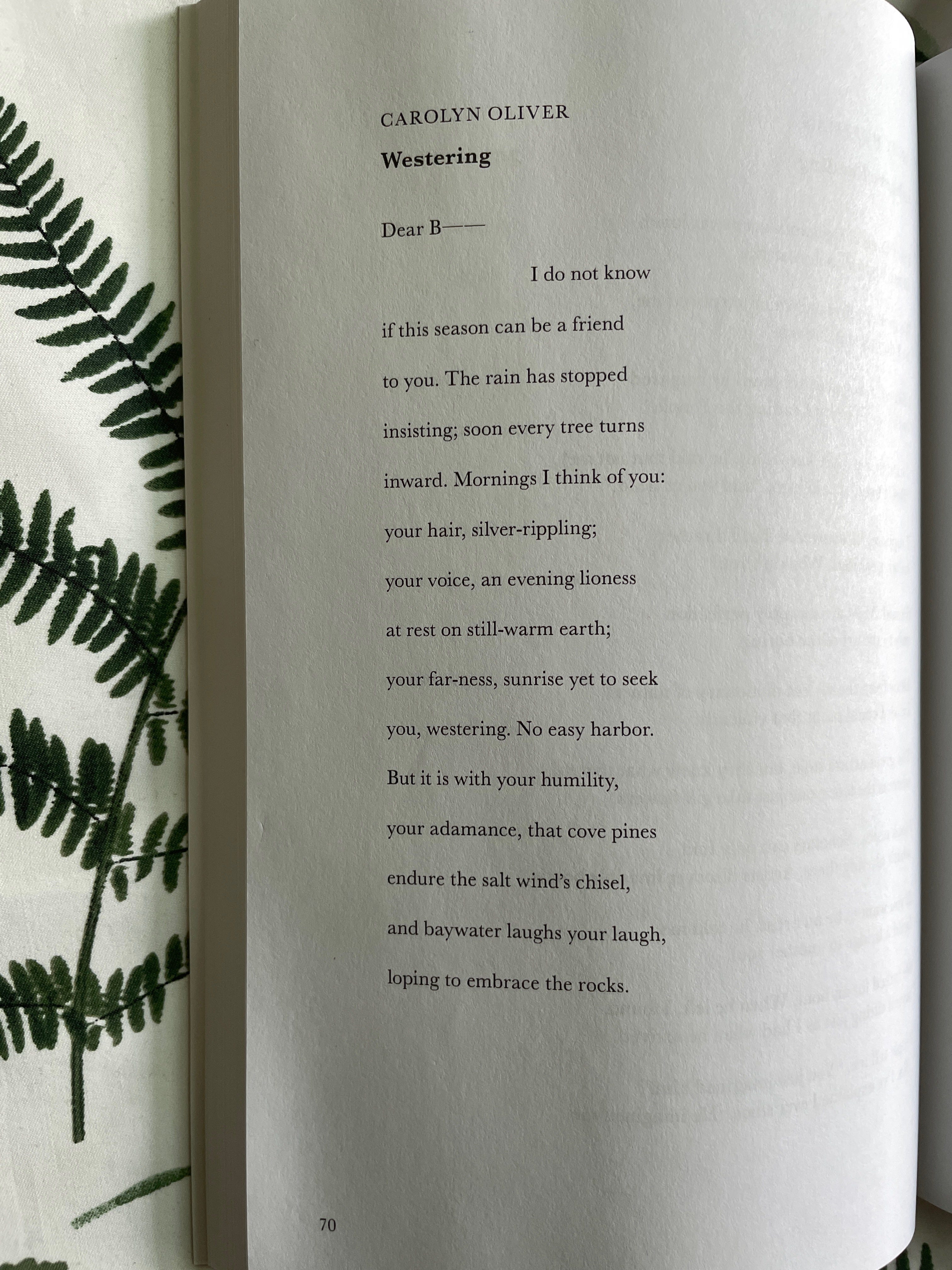
The title poem from The Blue Hour 🌊
Before you go, will you take a moment to hit the heart button or leave a quick comment about what strikes you here? This one simple action is incredibly effective at helping to spread the word about Bobbie’s work! I’d love it if you send it to a friend that you think might benefit from Bobbie’s wisdom and work. 🌊 🌱
Be Where You Are is a newsletter about how to use writing and mindfulness to live more fully where you are. To reply to this newsletter, just hit reply. I’d love to hear from you! You can also find me on Instagram/Facebook/Bluesky or find more info at my website.
Such a beautiful tribute to Bobbie, Emily! And her wisdom feels like such a gift for us ❤️
The idea of committing to the path, but holding it loosely, of bringing gentleness to a really hard state---it's about how attuned you are to who you are & what you need. Beautiful thoughts, beautiful woman. Thank you for introducing her; she's new to me.