
"Be an agent of change, not a victim of circumstance"
cultural anthropologist, writer, and Zen meditation practitioner Maia Duerr on her writing and mindfulness practices and how practice opens "a portal to creative work" ✨


This is a Beginner’s Mind interview, a series that explores the intersection of mindfulness and creative practice. Zen master Shunryū Suzuki Roshi said, “In the beginner’s mind, there are many possibilities; in the expert’s mind, there are few.” This series shines a light on the practices that sustain people in their daily lives and open the path to new possibilities. Subscribe for free below to make sure you don’t miss any future interviews. ✨
Today, I’m very excited to share an interview with Maia Duerr, cultural anthropologist, Zen meditation practitioner, and the author of one of my favorite Substack newsletters. Maia describes her newsletter, The Practice of Life, as “a space to explore what it means to live in these transformative (and often challenging) times from a place of awareness and kindness, and to offer you tools to cultivate those qualities in yourself.” Sounds like a space we all need right now, doesn’t it?
Maia’s voice cuts through the haze with clarity, compassion, and grounded strength. Whether you’re new to Maia’s work or have been following her for awhile, you’re in for a treat. She is so generous in her sharing of how her mindfulness practices “breathe in space for new possibilities.” Read on, friends.✨
What are your writing/creative practices? Do you have any rituals or habits that help you?
I usually begin a writing session with a short round of sitting meditation to clear my mind and welcome creativity to visit me (if I’m lucky!). I’ll light a candle, perhaps some incense as well, and settle into silence for a few minutes. Then I transition from that to picking up a pen and my journal. Usually I begin with handwriting rather than typing on my computer. I find that sensory experience of writing by hand, with a pen (I’ve never liked writing with a pencil!), is the best way to start connecting to my creative self.
Over the past year, I’ve worked a lot within the structure of the “Five Things” practice I learned from writer Summer Brennan. She describes it like this:
Start by writing down the number 1, like you’re beginning a list. Then write the first thing that comes to mind. To borrow from Ernest Hemingway, write one true sentence. Hemingway says to write “the truest sentence that you know,” but this might be intimidating to the overthinkers among us. Just quiet your mind for a moment and then write the first true thing that comes to you. Something you’ve been thinking about. Something you noticed or saw. There is no need for explanation or preamble—just dive right in.
When that “first thing” feels more or less complete, I stop for a few breaths and listen inside for what the next impulse is. I write the number 2, and then write into whatever is present next. That becomes the “second thing,” and so on until I’ve written five things. It’s a very intuitive practice, which I love about it. I don’t put any expectations on myself that the five things will be related to each other or that they have to form a cohesive essay – that can come later. This feels more like getting a box of paint colors out and playing around with hues and shades to see what patterns might start to develop. I find this really supportive of my creative process.
What are your mindfulness practices? Do you have your own definition or way of thinking about mindfulness? Can you describe your practices and what they bring into your life?
I see mindfulness as one of many contemplative practices. Here’s my personal definition of practice: An activity that I do on a regular basis (ideally each day) that helps me to cultivate a sense of self-awareness, joy, equanimity, resilience, and compassion for myself and others.
Many years ago I worked on a research project called The Contemplative Net. This was back before mindfulness became the buzzword it is now, if you can believe that. The goal of the project was to map the ways that contemplative practices were being used in secular settings. We interviewed people who were bringing mindfulness into places like schools, hospitals, businesses, courtrooms, social justice work, and more.
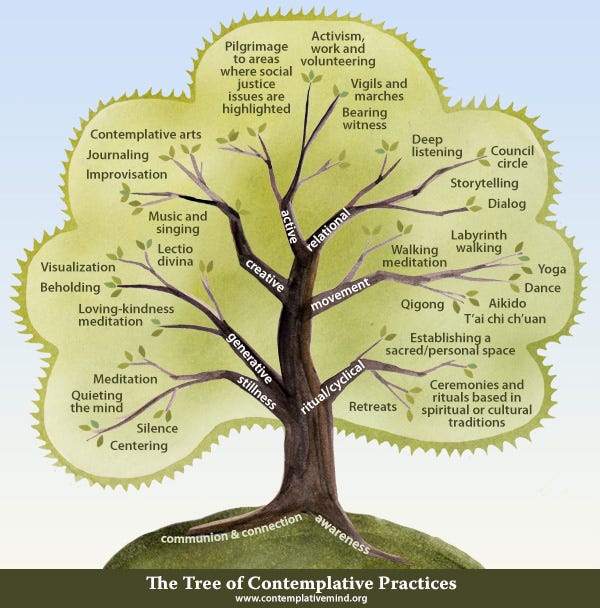
The definition I just shared with you arose out of listening to those teachers describe the multitude of ways they skillfully did this. The common thread was they tried their best to meet people where they were at, and creatively adapted the practices depending on what was needed. A practice could be almost anything – from yoga to making art to gardening to chanting and much more – as long as the intention is held to increase self-awareness as one is engaging in that activity. We even came up with a graphic to represent the diverse nature of practice as seen from this perspective – the Tree of Contemplative Practices. Many people have said it really helped them break through the idea that they weren’t “any good at meditation,” because they thought it could only be sitting meditation. To this day I think the Tree may be one of the best ideas I ever came up with!
My own fundamental practice is sitting meditation or what’s called zazen in the Zen Buddhist tradition. I use the word “fundamental” because as the years have gone by, I notice feeling more unbalanced and dysregulated on days I don’t begin with even a few moments of zazen. It’s not a pretty picture! I can get pretty cranky or zoned out when I haven’t sat in the morning. Zazen is such a simple practice – settling the body, becoming aware of breath, noting thoughts and feelings but not getting caught up in them, returning over and over to breath and body awareness – but it makes all the difference.
The other activity I’d call an essential practice in my life is walking – not formal walking meditation, but just your everyday walking outside. The practice dimension is present when I hold an intention for awareness while I’m walking. For me, that means tuning into my senses – feeling the sensation of my feet on the pavement or earth, listening to the sounds around me, noting the sights and changes in light as the seasons cycle through, and also noting thoughts and feelings as I would with sitting meditation.
There’s also a social element to walking, for me, it’s not just a solo activity. Up until a couple of months ago I’d walk several times a day with my elderly dog, and it was a joy to attune to each other’s pace and simply enjoy each other’s company. After a very long and wonderful life, she passed away in October. So now I’m getting used to taking those same walks by myself, and yet there is almost always someone along the road to say hi to, neighbors to chat with. I really appreciate that social aspect of the practice as well.
Do you have a mantra or motto related to your creative/mindfulness practices/life?
Yes! A very long time ago, this phrase came to me and I continue to say it to myself when I get caught in old patterns of helplessness, either in life or creative practices: Be an agent of change, not a victim of circumstance. I always thought that would make a great bumper sticker!
More recently, I was experiencing a lot of anxiety and worry as my elderly dog started to enter her last days with kidney disease. After a wonderful phone call with Chloe Hope, who is the author of Death & Birds here on Substack, I was able to reorient myself to the gifts inherent in that process. And quite naturally, another mantra came to me in the form of an acronym: SALT. That stands for Support, Abundance, Love, and Trust. Those were the qualities I was overlooking in my feeling of overwhelm. As I was gradually able to remind myself that those qualities are very present in my life, feelings of anxiety and worry began to subside.
What does the phrase “beginner’s mind” mean to you? Does it connect to your creative/or mindfulness practices?
I love that phrase. Zen Mind, Beginner’s Mind by Shunryu Suzuki Roshi was one of the first books I read when I was learning about Buddhism in the 90s, and for a time I lived at San Francisco Zen Center which is also known as Beginner’s Mind Temple (Hosshin-ji) – so that phrase has literally been part of my life!
To me it means always being willing to drop whatever idea I may have about someone or something, and allow myself to be surprised. It takes a lot of practice to be able to do that! Like most of us, I would imagine, I’ve been raised to be very averse to uncertainty and to feel like my thoughts are inviolable. Over time, in my experience, a meditation practice can loosen up that tight grip on one version of reality and breathe in space for new possibilities.
Of course this has very real and usually positive implications for creativity, which is nothing if not about new possibilities. I notice that the more consistent I am in my practice life, the easier it is for me to walk through the portal to creative work.
Are there any books / writers / teachers / approaches that have been transformative for you that you would recommend to readers?
One of the first writers who inspired me was Joan Didion. I still remember taking an English lit class in my first year of community college and being blown away when reading Didion’s Slouching Toward Bethlehem, which was assigned to us. A big light went off in my head, and I could feel the imperative: “This is what you are meant to do.” Didion’s writing was so precise and unflinching. She also wrote a lot about California, where I grew up, and I learned so much about the art of painting a literary picture by reading her descriptions.
Earlier I described the “Five Things” practice that Summer Brennan teaches – that’s definitely been transformative for me. Last year I went for a stretch of about six months when I had a near-daily writing practice using that form. Somewhere around the first month of doing that, I could feel how it changed how I moved through the world. I went from being a passive passenger on the ride of life to being an engaged participant. It was like putting on a pair of glasses and suddenly seeing sharp edges I hadn’t noticed before, picking up energetic flows in the way people spoke. Actually it was a bit like being on psychedelics! And the more I did that regular writing practice, the more I was able to move through that zone where writing is somewhat distant into a place that is fully embodied and revelatory. Any time I write something that surprises me, I know I’m on the right track.
I find Annie Dillard’s book The Writing Life to be a profound guide to being a writer. One of my favorite lines: “One of the things I know about writing is this: spend it all, shoot it, play it, lose it, all, right away, every time. Do not hoard what seems good for a later place in the book or for another book; give it, give it all, give it now.”
One other writer/poet I’m really enjoying these days is Sal Randolph, who has a Substack called Free Words. Sal plays with different poetic forms – with an emphasis on play! – and frequently offers exercises to stoke the reader’s own creative fires. She’s the author of The Uses of Art, which I haven’t read yet but as I’m talking to you, I’m thinking I need to order right after I finish this interview! And as it happens, Sal is another Zen practitioner who embodies a beautiful intersection between mindfulness and creativity.
A Prompt from Maia ✨
This prompt leans a bit more toward self-awareness than it does pure creativity, but that’s a fine distinction. You may find that this exercise opens up your creative headwaters. It’s also a meditation on mortality.
What would your life look like if you knew you had a year to live? What would rise to the top of importance for you? What would fall away? Who would you want to spend time with? How would you want to spend your time? Where would you want to be?
Now take those same questions and shift the time frame:
What if you knew you had one month to life? How about one week?
How do those shifting time frames change or not change your responses? What did you learn about yourself from your answers that you might want to incorporate in your life, now?
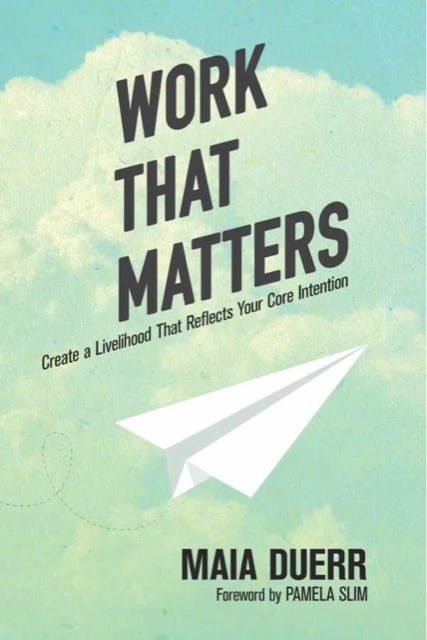
A cultural anthropologist, writer, and longtime Zen meditation practitioner, Maia Duerr offers mindfulness and other reflective practices that cultivate compassion, awareness, and social transformation. Maia is the author of Work That Matters: How to Create a Livelihood That Reflects Your Core Intention (Parallax Press), and she takes joy in supporting people to find the work they are meant to do, as well as to navigate through life transitions with mindful awareness. She offers Guidance + Encouragement sessions (kinda like coaching but not exactly) for these purposes. You can learn more about her and her body of work on her website. You can find Maia on Substack and subscribe to her excellent newsletter below (high recommend obviously!)👇🏼


More from Maia ✨
Read an excerpt of Maia’s book HERE.
I recommend these two pieces by Maia for support in our political moment: “3 Spiritual and Practical Keys to Make it Through End Times Fascism” and her follow-up, “The Power of Community.”
Your turn: Do you have any other questions for Maia? Ask away!
Catching up with Beginner’s Mind alums
Ankur Shah gave an inspiring sermon titled, “Love and Serve Where You Stand” at the Olympic Unitarian Universality Fellowship. Must-watch.
Ryan Rose Weaver (she/hers)’s interview with Dacy Gillespie on “Bringing mindfulness to getting dressed” is deeply wise and helpful.
Maria Bowler is doing so many cool things: I adore these memes on IG; I am loving her anti-advice, like this one, “On becoming a bad investment.”
Before you go, will you take a moment to hit the heart button or leave a quick comment about what strikes you here? This one simple action is incredibly effective at helping to spread the word about Maia’s work! I’d love it if you send it to a friend that you think might benefit from Maia’s wisdom and work. ✨ Or, gift a Be Where You Are subscription to a friend who would love it! ✨
Be Where You Are is a newsletter about how to use writing and mindfulness to live more fully where you are. To reply to this newsletter, just hit reply. I’d love to hear from you! You can also find me on Instagram/Facebook/Bluesky or find more info at my website.
 | A guest post by
|